
 Post by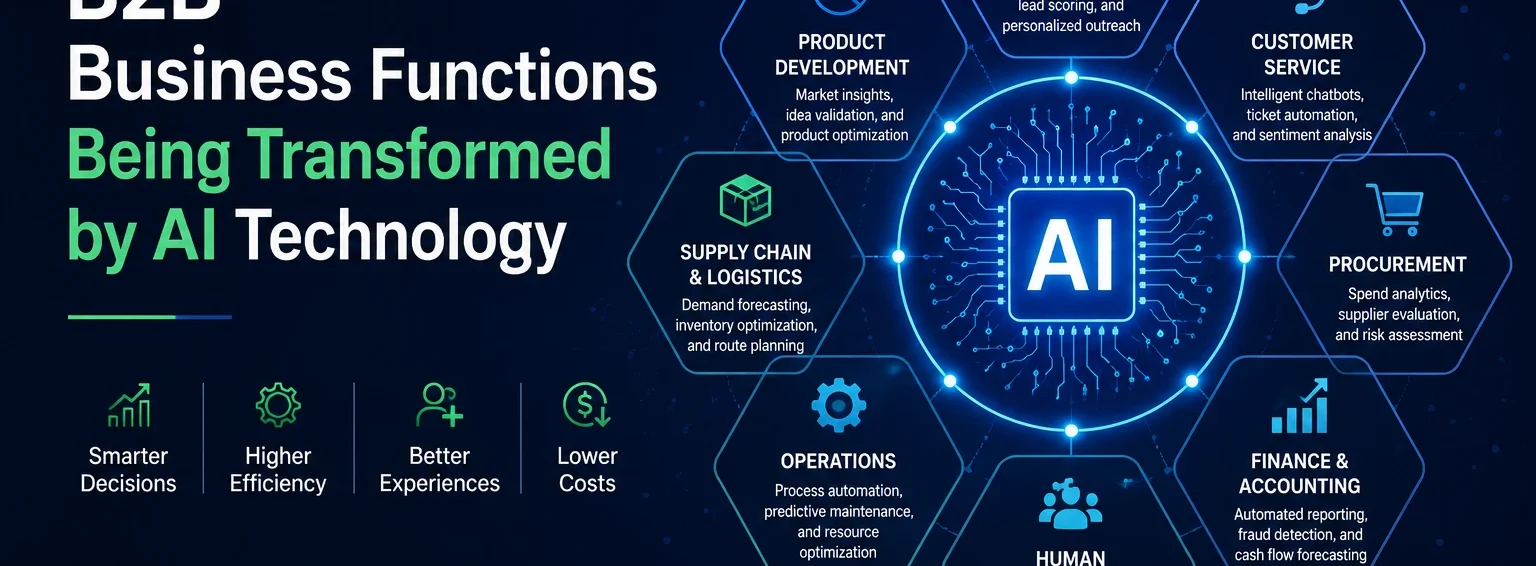
Introduction
AI is no longer a buzzword sitting in a boardroom presentation. For B2B companies, it has become the backbone of smarter operations, faster decisions, and measurable growth. From identifying the right leads to managing financial risk, artificial intelligence is reshaping how businesses compete and deliver value.
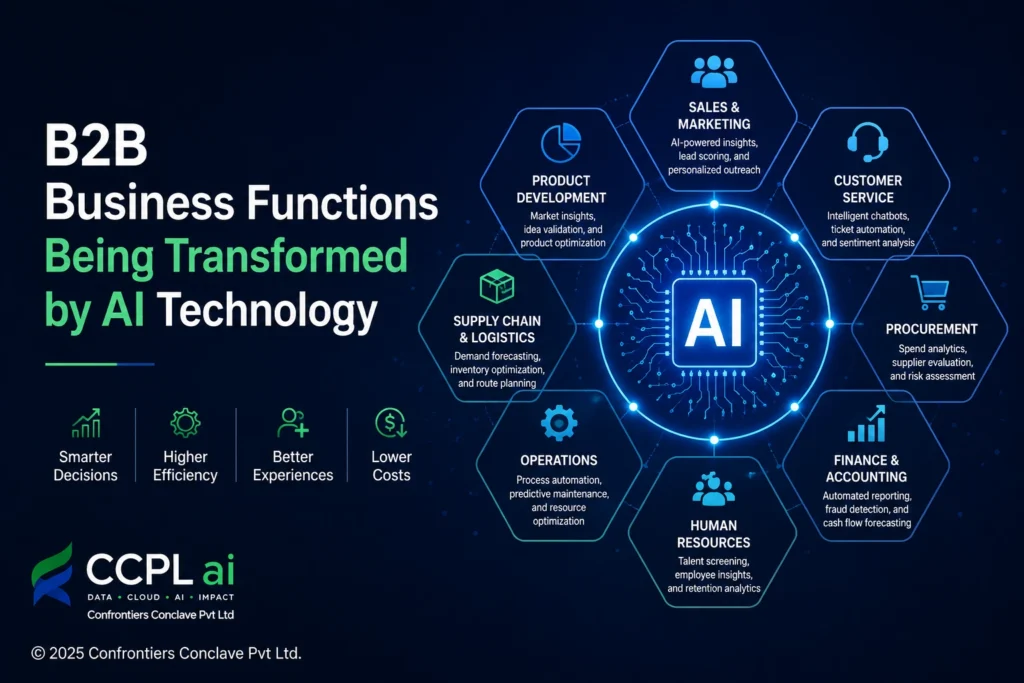
The companies pulling ahead aren’t waiting for AI to become “mainstream.” They’re already deploying it across their core functions. Here are five B2B business areas where AI is making the biggest impact right now.
Marketing: From Guesswork to Data-Driven Precision
Sales: Smarter Prospecting, Higher Conversion Rates
Every B2B sales professional knows the pain of chasing cold leads that go nowhere. AI eliminates much of that friction by enabling intelligent prospecting at scale.
Using data analytics, AI-powered prospecting tools can scan massive datasets to identify companies and decision-makers that match your ideal customer profile with precision. But it goes beyond just generating a list – AI adds context. It surfaces buying signals, company growth indicators, industry trends, and engagement history, giving sales reps a much clearer picture of who they’re calling and why, before the first conversation even starts.
This means shorter sales cycles, higher confidence in outreach, and significantly better response rates. Sales teams spend less time hunting and more time closing.
Customer Support: Faster Resolutions, Stronger Relationships
B2B customer support is complex. Clients often deal with intricate contracts, technical integrations, and specialized products – and they expect fast, accurate answers.
AI is stepping up to meet those expectations. Intelligent chat systems handle routine queries instantly – order status, account information, troubleshooting steps – without putting customers on hold. For issues that require human intervention, AI pre-collects all relevant context so support agents arrive fully briefed, cutting resolution time dramatically.
The impact goes beyond speed. When customers get consistent, reliable support, trust in your business deepens. That’s especially critical in B2B, where long-term relationships drive revenue.
Finance and Risk Management: Precision at Every Level
Numbers are the language of business, and AI has become remarkably fluent. In finance and risk management, AI is processing complexity at a speed and accuracy no human team can match.
Fraud detection is one of the most powerful applications. AI monitors transaction patterns in real time and flags anomalies far faster than manual review ever could, protecting businesses from significant losses. In risk management, AI models assess customer payment histories, market data, global events, and credit signals to forecast the likelihood of defaults or delays before they happen.
Budgeting and financial forecasting have also become sharper. Rather than relying purely on historical figures, AI factors in seasonality, supply chain variables, competitor behavior, and macroeconomic signals – producing projections that are not just more accurate but genuinely useful for strategic planning.
For finance leaders, this means fewer surprises and more confident decisions.
Human Resources: Smarter Hiring, Better Retention
Finding and keeping the right people is one of the hardest challenges in any B2B organization. AI is changing the equation on both sides of that equation.
On the hiring side, AI screens resumes and applications at scale – surfacing the candidates most aligned with the role based on skills, experience, and performance indicators rather than subjective criteria. For high-volume recruitment, this dramatically reduces time-to-hire. It also reduces unconscious bias, helping companies build more diverse and capable teams.
Once employees are onboarded, AI continues to add value. Learning and development platforms powered by AI recommend personalized training paths based on individual performance data. Predictive analytics can also identify employees who may be at risk of leaving, giving HR teams the chance to intervene early before valuable talent walks out the door.
Companies using B2B migration services to modernize their HR tech stack are finding that AI integration accelerates these gains significantly.
Final Thoughts
AI isn’t transforming B2B businesses all at once – it’s doing it function by function, decision by decision. The companies that recognize where AI delivers the clearest ROI and act on it early are the ones building a durable competitive advantage.
Whether it’s sharper marketing, smarter sales prospecting, faster support, tighter financial control, or stronger talent management, the technology is already proven. The only question is how quickly your business will put it to work.