
Introduction
Most FMCG companies are not lacking data. They are lacking visibility.
Sales reports arrive too late. Inventory decisions depend on disconnected spreadsheets. Supply chain teams react to problems after they already affect operations. Marketing campaigns launch without clear forecasting confidence. And leadership teams often struggle to see real-time business performance across regions, distributors, and product categories.
That was exactly the challenge faced by one of India’s growing FMCG brands before partnering with CCPL.AI.
The company had strong market demand and a rapidly expanding distribution network, but operational complexity was increasing faster than internal visibility. Teams were spending more time gathering data than using it.
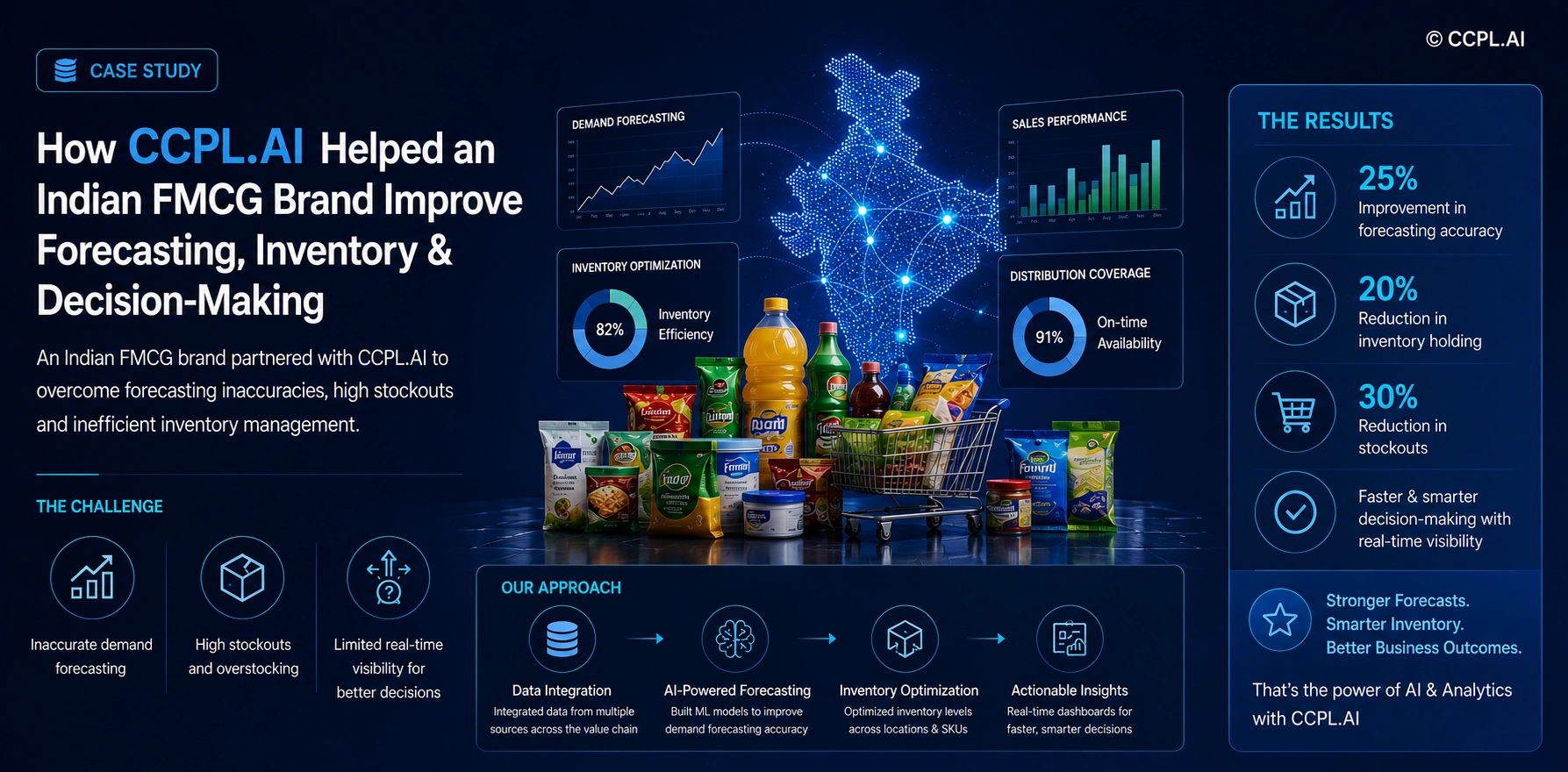
CCPL.AI helped the organization build a centralized FMCG analytics ecosystem that transformed forecasting accuracy, inventory planning, operational reporting, and business decision-making.
This case study explains the challenge, the solution architecture, the implementation process, and the measurable business outcomes achieved through advanced data analytics and AI-powered business intelligence.
TL;DR
- AI helped an FMCG company modernize analytics and forecasting operations.
- The business struggled with fragmented reporting and inventory inefficiencies.
- A centralized analytics platform improved operational visibility and decision-making.
- Predictive analytics improved forecasting accuracy and inventory planning.
- The company achieved measurable improvements in efficiency and operational performance.
About the Customer
The client is a fast-growing Indian FMCG company operating across multiple product categories and regional markets.
The organization manages large-scale inventory movement, distributor operations, retail relationships, and supply chain coordination across a rapidly expanding network.
As the business scaled, leadership recognized that traditional reporting systems were no longer sufficient for operational complexity. Teams were relying heavily on manual reporting, disconnected Excel workflows, and delayed performance visibility.
The company needed a scalable analytics foundation capable of supporting data-driven operations, forecasting, and executive decision-making.
The Business Challenges
Before partnering with CCPL.AI, the company faced several operational and analytics challenges.
These included:
• Fragmented data across departments and systems
• Delayed operational reporting
• Inconsistent inventory visibility
• Forecasting inaccuracies
• Limited real-time analytics capabilities
• Slow executive decision-making
• Difficulty identifying regional demand patterns
• Manual reporting dependencies
The company’s existing infrastructure created operational blind spots that impacted planning accuracy, inventory efficiency, and overall business agility. Leadership teams often lacked a unified view of performance across distributors, sales regions, and product categories. This reduced forecasting confidence and made proactive decision-making difficult.
Primary Business Objectives
The organization partnered with CCPL.AI to modernize its analytics infrastructure and improve operational intelligence.
The primary objectives included:
• Centralize analytics and reporting systems
• Improve inventory visibility
• Increase forecasting accuracy
• Enable real-time business intelligence
• Reduce manual reporting workloads
• Improve supply chain visibility
• Strengthen distributor performance tracking
• Support faster executive decision-making
The long-term goal was not simply reporting improvement. The company wanted to build a modern data-driven operational ecosystem capable of supporting future growth.
CCPL.AI’s Analytics Solution
CCPL.AI designed and implemented a centralized FMCG analytics platform focused on operational visibility, forecasting intelligence, and executive reporting.
The solution combined:
• Unified data pipelines
• Real-time analytics dashboards
• Predictive forecasting models
• Inventory intelligence systems
• KPI monitoring frameworks
• Executive business intelligence dashboards
• AI-powered analytics recommendations
Data from ERP systems, distributor networks, inventory databases, and operational workflows was consolidated into a centralized analytics environment. This created a single source of truth across business operations.
Predictive Analytics & Forecasting Improvements
One of the most impactful improvements involved predictive analytics.
CCPL.AI implemented machine learning forecasting models designed to identify demand trends, seasonal fluctuations, and inventory risk patterns.
The analytics models incorporated:
• Historical sales data
• Regional purchasing behavior
• Seasonal demand trends
• Inventory movement
• Distribution performance
• Product-level analytics
This helped the business move away from reactive inventory planning toward predictive operational management. Improved forecasting accuracy reduced stockout risk, improved replenishment timing, and strengthened distributor coordination. Industry research consistently highlights predictive analytics as one of the most valuable applications in FMCG operations and supply chain optimization.
Operational Dashboard Transformation
CCPL.AI also redesigned the organization’s operational reporting environment.
Instead of relying on disconnected spreadsheets and delayed reports, leadership teams gained access to centralized dashboards with real-time operational visibility.
The new analytics environment provided:
• Inventory performance tracking
• Order fulfillment monitoring
• Regional sales visibility
• KPI dashboards
• Forecast variance analysis
• Distribution performance metrics
• Operational trend analysis
This significantly improved executive decision-making speed and reduced manual reporting dependency across departments.
Business Impact & Measurable Results
The transformation delivered measurable operational improvements across multiple business functions.
Key outcomes included:
• Improved forecasting accuracy
• Faster operational reporting
• Better inventory visibility
• Reduced manual reporting workload
• Improved distributor coordination
• Faster leadership decision-making
• Stronger operational transparency
• Improved supply chain planning
The company also gained the ability to identify operational risks earlier and respond faster to market changes. Research across the FMCG sector increasingly shows that businesses using predictive analytics and centralized intelligence systems improve operational agility and decision-making performance significantly.
Why FMCG Businesses Are Investing Heavily in Analytics
The FMCG industry operates in an environment where operational speed, forecasting accuracy, and customer demand visibility directly affect profitability.
That is why analytics investment across FMCG businesses continues accelerating globally.
Modern FMCG analytics systems help businesses:
• Improve inventory optimization
• Reduce stockouts
• Forecast demand more accurately
• Improve distributor coordination
• Optimize promotions
• Strengthen supply chain visibility
• Improve customer targeting
Industry reports increasingly emphasize that disconnected systems and fragmented reporting create operational inefficiencies across FMCG organizations. Centralized analytics environments are becoming critical for modern business scalability.
How CCPL.AI Helps FMCG Businesses Modernize
CCPL.AI helps FMCG companies build scalable analytics ecosystems designed for operational intelligence and business growth.
Our solutions include:
• Predictive analytics
• Business intelligence dashboards
• Inventory analytics
• AI-powered forecasting
• Data engineering
• Supply chain analytics
• KPI monitoring systems
• Enterprise reporting modernization
We focus on building analytics systems that support real operational decisions — not just reporting dashboards. Because in modern FMCG operations, visibility is no longer optional.
It is a competitive advantage.
Conclusion
The FMCG industry is becoming increasingly data-driven.
Businesses that modernize analytics infrastructure today will adapt faster, forecast better, and operate more efficiently tomorrow.
This case study demonstrates how centralized analytics, predictive intelligence, and operational visibility can transform business performance across forecasting, inventory management, and executive decision-making.
At CCPL.AI, we help organizations move beyond fragmented reporting and build intelligent analytics ecosystems designed for measurable business impact.