
Introduction
For many enterprises, ERP systems are the operational backbone of the business.
Finance, procurement, inventory, HR, supply chain operations, manufacturing workflows, customer management, and reporting systems all depend heavily on ERP infrastructure.
But over time, many organizations outgrow legacy ERP environments.
Older systems become difficult to maintain, expensive to scale, slow to integrate with modern technologies, and increasingly unable to support real-time operational visibility.
That was exactly the challenge faced by one of CCPL.AI’s enterprise clients before beginning a large-scale ERP modernization initiative.
The organization needed to modernize operations without disrupting the systems employees and customers relied on every day.
CCPL.AI designed and executed a secure ERP migration strategy focused on scalability, operational continuity, data integrity, and long-term business flexibility.
This case study explains the challenge, the migration approach, the solution architecture, and the measurable business impact achieved through enterprise ERP transformation.
TL;DR
- AI helped an enterprise modernize legacy ERP infrastructure.
- The organization struggled with fragmented workflows and limited scalability.
- A phased ERP migration reduced operational risk and downtime.
- Cloud-enabled ERP modernization improved reporting, automation, and visibility.
- The company achieved measurable operational efficiency improvements.
About the Customer
The client is a large enterprise organization managing complex operational workflows across multiple departments and business units.
The organization relied heavily on legacy ERP infrastructure to support finance operations, inventory management, procurement workflows, reporting systems, and operational planning.
As the company expanded, operational complexity increased significantly.
The existing ERP environment created performance bottlenecks, reporting delays, integration limitations, and growing infrastructure maintenance costs.
Leadership recognized that modernization was necessary to support scalability, improve operational efficiency, and enable future digital transformation initiatives.
The Business Challenges
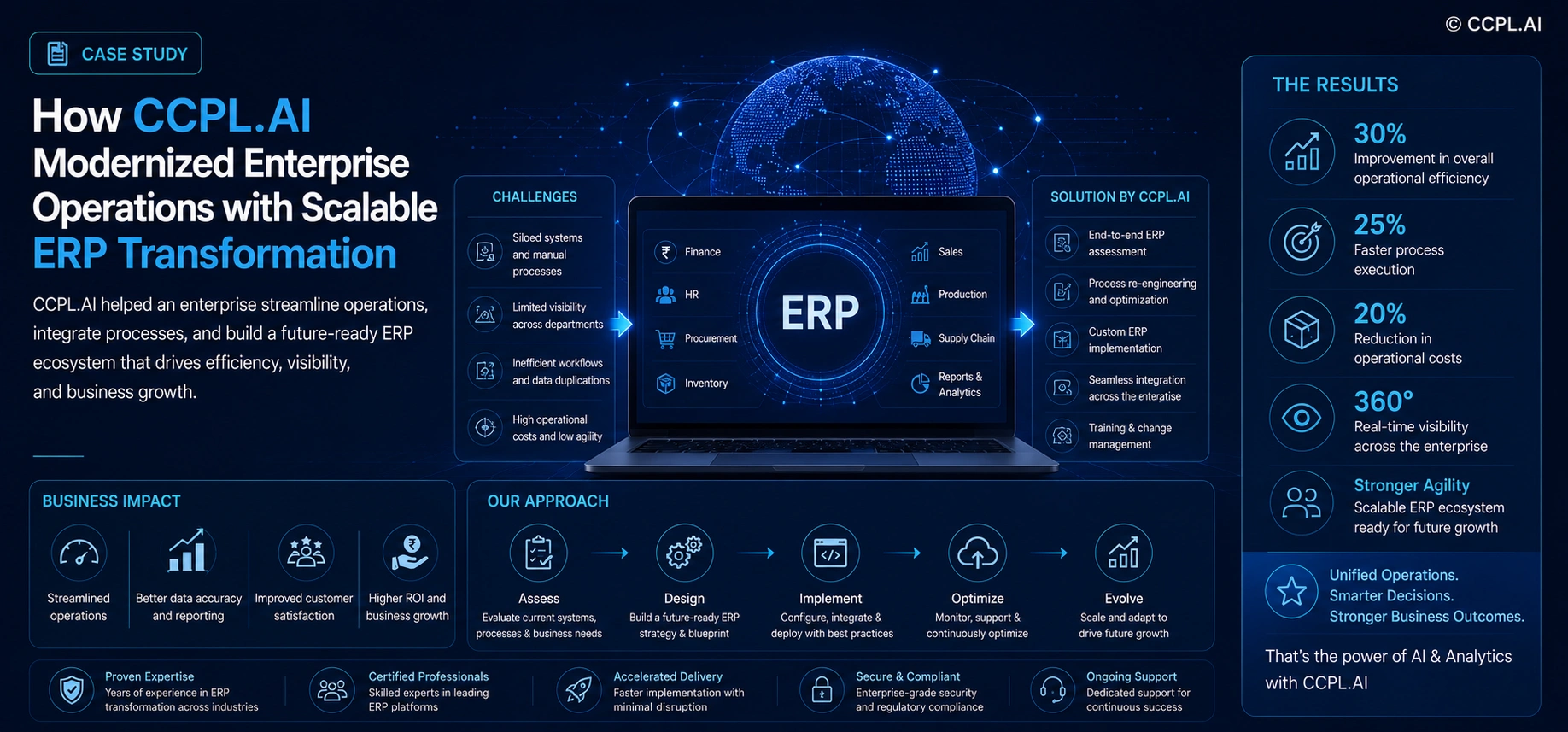
Before partnering with CCPL.AI, the organization faced several operational and infrastructure challenges related to its legacy ERP environment.
These included:
• Limited system scalability
• Slow reporting and data processing
• Fragmented workflows across departments
• Difficult third-party integrations
• High infrastructure maintenance costs
• Operational inefficiencies caused by manual processes
• Limited real-time visibility into business performance
• Growing security and compliance concerns
The organization also faced significant concerns around migration risk, downtime, and data integrity. Leadership needed a modernization strategy capable of improving operations without disrupting business continuity.
Primary Objectives
The organization partnered with CCPL.AI to modernize ERP infrastructure while minimizing operational disruption.
The primary objectives included:
• Migrate legacy ERP systems securely
• Improve operational scalability
• Reduce infrastructure complexity
• Improve reporting and analytics visibility
• Strengthen workflow automation
• Enable cloud-based flexibility
• Improve data governance and security
• Reduce manual operational dependencies
The broader goal was to create a future-ready operational environment capable of supporting long-term growth and digital transformation.
CCPL.AI’s ERP Migration Strategy
CCPL.AI designed a phased ERP migration strategy focused heavily on risk reduction, operational continuity, and scalability.
The migration approach included:
• Infrastructure assessment
• Data mapping and cleansing
• System dependency analysis
• Cloud migration planning
• Workflow modernization
• Security and compliance validation
• Testing and rollback preparation
• User enablement and training
Instead of attempting a high-risk “big bang” migration, CCPL.AI implemented phased modernization designed to reduce downtime and operational disruption. This allowed teams to validate workflows incrementally while maintaining business continuity.
Cloud ERP Modernization
A major component of the transformation involved cloud-enabled ERP modernization.
The organization moved from infrastructure-heavy legacy environments toward scalable cloud architecture designed for flexibility, operational visibility, and future integration readiness.
The modernized ERP ecosystem improved:
• System scalability
• Remote accessibility
• Reporting performance
• Infrastructure management
• Integration flexibility
• Disaster recovery preparedness
Cloud modernization also created stronger foundations for future analytics, automation, and AI initiatives. Industry research increasingly highlights cloud ERP transformation as a major operational priority for enterprises modernizing legacy infrastructure.
Data Migration & Governance
ERP migration projects are heavily dependent on data quality and governance.
CCPL.AI implemented structured migration frameworks focused on:
• Data cleansing
• Validation testing
• Secure transfer protocols
• Access governance
• Compliance monitoring
• Backup and rollback protection
The migration process ensured that operational data remained accurate, secure, and accessible throughout the transformation lifecycle.
Strong governance significantly reduced migration risk while improving long-term reporting reliability.
Operational Improvements After Migration
After implementation, the organization experienced measurable operational improvements across departments.
Key improvements included:
• Faster reporting cycles
• Improved workflow efficiency
• Better cross-department collaboration
• Reduced manual operational workload
• Improved visibility into operational performance
• Stronger infrastructure scalability
• Improved integration flexibility
• Better operational responsiveness
Leadership teams gained faster access to operational insights while employees benefited from more streamlined workflows and improved system performance.
Why ERP Migration Is Accelerating in 2026
ERP modernization demand continues increasing globally as enterprises move toward cloud infrastructure, automation, analytics, and AI-driven operations.
Legacy ERP systems often create limitations around:
• Scalability
• Integration
• Reporting speed
• Operational visibility
• Security
• Maintenance costs
Modern ERP environments provide greater operational flexibility and support faster business adaptation. Organizations modernizing ERP infrastructure today are positioning themselves for stronger long-term scalability and operational agility.
How CCPL.AI Helps Enterprises Modernize Operations
CCPL.AI helps enterprises modernize operational infrastructure through scalable ERP transformation strategies.
Our capabilities include:
• ERP migration services
• Cloud ERP modernization
• Legacy system transformation
• Data migration
• Workflow automation
• Business intelligence integration
• Infrastructure modernization
• Enterprise analytics enablement
We focus on building operational ecosystems that improve scalability, efficiency, and long-term business flexibility. Because successful ERP modernization is not just about replacing systems. It is about improving how businesses operate every day.
Conclusion
This ERP migration case study demonstrates how modern enterprise transformation requires more than infrastructure replacement. Successful modernization depends on operational planning, governance, scalability, security, and business continuity.
By implementing a phased ERP migration strategy, CCPL.AI helped the organization modernize operations while reducing operational risk and improving long-term business flexibility.
As enterprises continue modernizing infrastructure in 2026 and beyond, scalable ERP transformation will remain a critical foundation for analytics, automation, AI adoption, and operational growth.